
Autonomous vehicles are designed to move safely without direct human control by combining advanced sensors, artificial intelligence, and real time decision systems. These vehicles analyze surroundings continuously, interpret road conditions, and respond to traffic situations faster than traditional human driven vehicles.
Understanding how self driving cars function helps explain why they are considered a major step forward in transportation technology and road safety.
What Is an Autonomous Car
An autonomous car is a vehicle capable of sensing its environment and navigating without manual steering, acceleration, or braking from a human driver.
Instead of relying only on driver input, these vehicles depend on:
- Sensors
- Cameras
- Radar systems
- Artificial intelligence software
- High precision maps
- Control algorithms
Together, these components allow the vehicle to observe, analyze, and act independently.
The Core Technologies Behind Self Driving Cars
Autonomous vehicles operate through a coordinated system of hardware and software working together in real time.
Key technologies include:
- Sensor networks
- Machine learning systems
- Mapping technology
- Decision making software
- Vehicle control systems
Each layer plays a specific role in ensuring safe navigation.
Sensors Help Vehicles Understand Their Surroundings
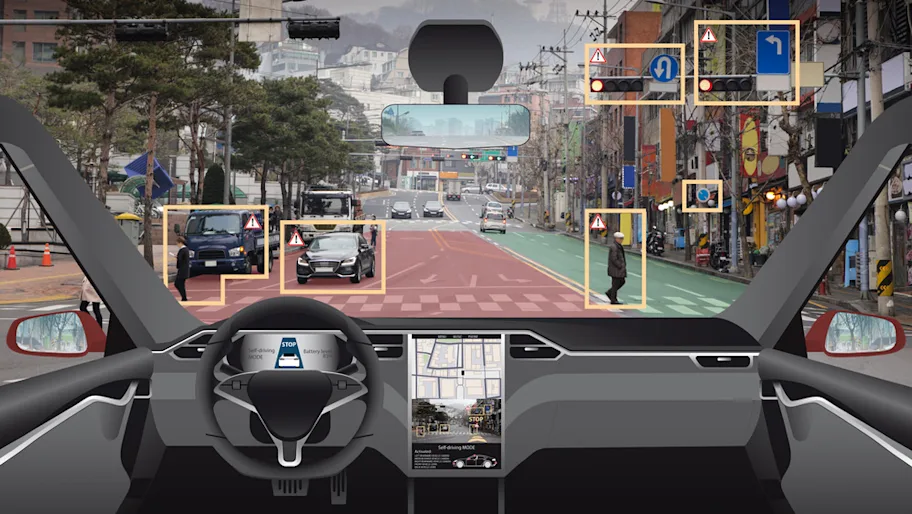
Sensors act as the eyes and ears of autonomous vehicles. They constantly monitor road conditions and nearby objects.
Common sensors include:
Lidar
Lidar uses laser pulses to measure distances between the vehicle and surrounding objects. It creates a detailed three dimensional view of the environment.
Radar
Radar detects the speed and distance of nearby vehicles and works reliably even during rain, fog, or low visibility conditions.
Cameras
Cameras identify road signs, traffic lights, pedestrians, lane markings, and obstacles.
Ultrasonic sensors
These sensors help during short range detection tasks such as parking and maneuvering in tight spaces.
Together, these sensors create a complete understanding of the vehicle’s surroundings.
Artificial Intelligence Enables Decision Making
Artificial intelligence allows autonomous vehicles to interpret data collected from sensors and choose appropriate driving actions.
AI systems help vehicles:
- Recognize pedestrians and cyclists
- Detect road markings
- Identify traffic signals
- Predict movement of nearby vehicles
- Adjust driving behavior accordingly
Machine learning models improve performance over time by learning from large driving datasets.
High Definition Maps Support Accurate Navigation
Self driving vehicles rely on highly detailed digital maps that include precise road geometry and traffic information.
These maps provide:
- Lane level positioning
- Road curvature details
- Speed limits
- Traffic signal locations
- Intersection layouts
Combined with GPS and sensor data, these maps help vehicles maintain accurate positioning.
Sensor Fusion Combines Multiple Data Sources
Sensor fusion is the process of merging data from multiple sensors to create a reliable understanding of the environment.
For example:
- Cameras identify objects visually
- Radar measures distance and speed
- Lidar builds spatial structure
When combined, these inputs produce a clearer and more accurate interpretation than any single sensor alone.
Control Systems Operate Steering and Braking
Once the vehicle understands its surroundings and decides how to respond, control systems carry out physical driving actions.
These systems manage:
- Steering adjustments
- Acceleration control
- Braking responses
- Lane positioning
- Speed regulation
Control commands are executed within milliseconds to maintain safe movement.
Levels of Vehicle Autonomy
Autonomous driving capability is classified into different levels depending on how much control the vehicle has compared to the driver.
These levels include:
Level 0
The driver performs all driving tasks.
Level 1
The vehicle assists with either steering or speed control.
Level 2
The vehicle manages both steering and acceleration but still requires driver supervision.
Level 3
The vehicle can drive independently in certain environments while the driver remains available if needed.
Level 4
The vehicle operates without driver input in most conditions within specific areas.
Level 5
The vehicle performs all driving tasks under all conditions without any human involvement.
Most currently available vehicles operate between Level 2 and Level 3 autonomy.
Communication Systems Improve Road Awareness
Autonomous vehicles can communicate with external infrastructure and nearby vehicles to improve safety.
These communication systems support:
- Traffic signal coordination
- Collision warnings
- Road hazard alerts
- Navigation updates
- Traffic flow optimization
Vehicle to vehicle communication helps create cooperative traffic environments.
Safety Systems Reduce Human Error Risks
Human error is a major cause of road accidents. Autonomous vehicles aim to reduce this risk by maintaining constant awareness and faster reaction times.
Safety advantages include:
- Continuous environment monitoring
- No distraction related delays
- Consistent speed control
- Predictive hazard detection
- Immediate braking response
These capabilities contribute to safer driving conditions over time.
Frequently Asked Questions
1. Can autonomous cars drive in all weather conditions
Performance may be affected during extreme weather such as heavy snowfall or dense fog because sensors rely on visibility and surface detection accuracy.
2. Do self driving cars require internet connectivity to operate
Basic driving functions do not require continuous internet access, but connectivity improves map updates, traffic information, and communication features.
3. Are autonomous vehicles legal everywhere
Regulations vary by country and region. Some locations allow testing while others permit limited commercial deployment under supervision.
4. How do autonomous cars recognize pedestrians at night
They use infrared capable sensors, radar detection, and machine learning based image recognition systems designed for low light environments.
5. Can autonomous vehicles prevent all accidents
They significantly reduce certain types of accidents but cannot eliminate every possible road risk due to unpredictable conditions.
6. How long does it take autonomous systems to react to obstacles
Vehicle control systems respond within milliseconds after detecting hazards through sensor processing and decision algorithms.
7. Will autonomous vehicles replace traditional drivers completely
Full replacement is unlikely in the near future. Instead, autonomous technology is expected to gradually assist drivers and improve transportation safety and efficiency.